One of the earliest mentions of Brazen Tor is by Frank Rutley from 1878 (cited in Rowe) where, speaking of the junction of amphibolite and granite at the tor, he writes: "the granite close to the contact is very fine grained and felstone like, loose blocks showing black nests and segregations of schorl, it becomes more and more porphyritic toward the Tor itself." Over the centuries there have been numerous variations on the name of the tor as seen in the aka list above.
Writing in 1901, William Crossing describes the tor as "a small pile not far from Bagga Tor" but sometime thereafter the substance of the tor seems to have been dismantled.
By 1983 Eric Hemery includes this short reference in High Dartmoor: "The small rock-pile of elvan from which the farm was first named, Brownsdon Tor (approx. 1070 feet), lies a ruin in the field east of the farm lane. Much of the tor has been taken for building-material - even for the medieval wall seen running from it - and the clitter cleared to the edge of the field, many years ago, by horse-power." This assessment leads Terry Bound (1995) to label the site as 'bogus', and in 1998 Tim Jenkinson included Brouzen Tor as one of the 'Lost Tors' of Dartmoor where he concludes: "Quite simply a pitiful sight, the large heaps of granite blocks signify a rather undignified end to a tor's existence."
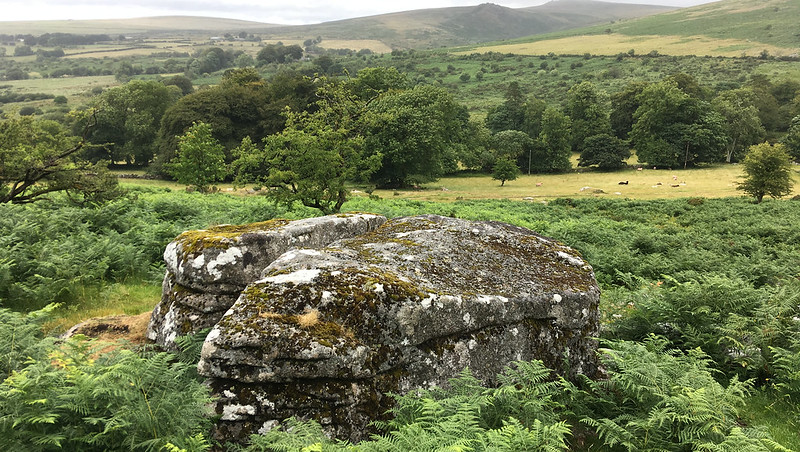
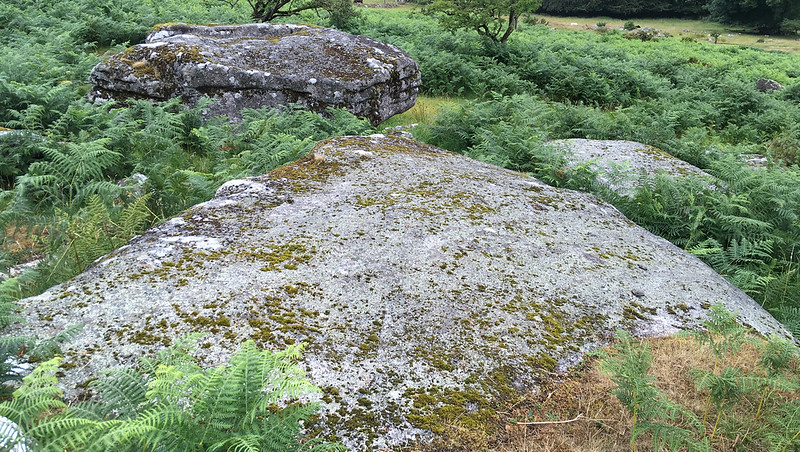
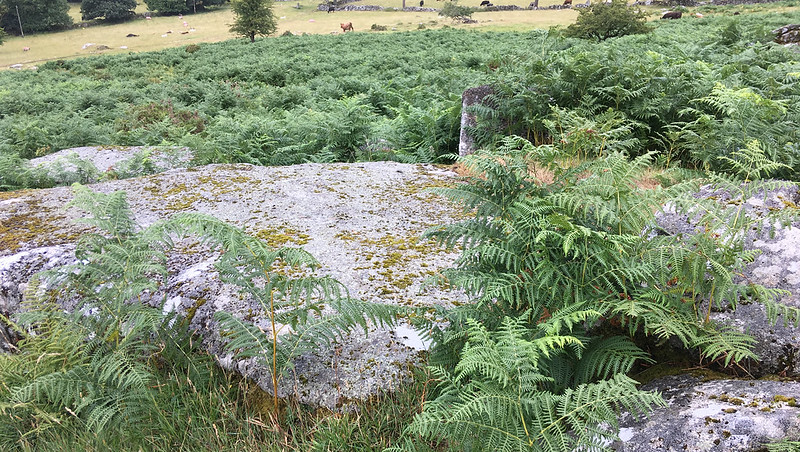
Nowadays there is a small granite outcrop in a field above Baggator Farm with several flat and scattered boulders nearby but most of the rocks still in evidence in the 1990s have since been removed. Although on private land, the remains of the tor can be viewed from the field entrance. Like nearby Bagga Tor, this outcrop is actually granite rather than the 'elvan' referred to by Hemery. The mistake on the rock type is understandable because, and very much like its neighbour, it sits just on the edge of the granite that, according to Collingwood (2019), and Rutley many years before, "Has been affected by hydrothermal fluids leaving the rock riddled with pink veins of quartz and tourmaline."
Brousentor Farm gained some unwanted notoriety in 1890 when it was the subject of a bizarre shooting incident. Appearing under the heading 'GUN ACCIDENT NEAR TAVISTOCK' this account appeared in the Western Times of July 29th:
"Richard Bassett, aged ten, and John Bassett, aged eight, children of William Bassett, residing at Browsentor farm on Dartmoor, found themselves alone at their home on Friday afternoon, when the elder boy took his father's muzzle-loading gun from its place over the mantelpiece and went into the lane adjoining. The younger boy followed, and while Richard was playing with the gun it exploded, and a portion of the charge struck the head of his brother, who was standing about fourteen yards distant, and knocked him insensible, while the recoil of the weapon also knocked down Richard and bruised his lips. Thomas Maunder, who was working near, came to the scene and carried the in-sensible child into his home. The father on his return shortly after from the Tavistock market fetched Dr. Hislop who found that although some of the shots had lodged in the little sufferer's head there was no fracture of the skull. He had not recovered consciousness on Saturday afternoon and lies in a dangerous condition, suffering from concussion of the brain and shock to the system."
The good news is that in the Census returns of the following year 1891 John is recorded as living at Browsentor with his parents and four siblings including Richard, so he thankfully survived the ordeal.
Brousentor
The map above is not a navigation tool and we recommend that the grid reference shown below is used in conjunction with an Ordnance Survey map and that training in its use with a compass is advised.
Grid Ref:
SX 5471 8072
Height:
330m
Parish:
Peter Tavy
Tor Classification:
Ruined
Access:
Private (but visible from public land)
Rock Type:
Granite
Credit:
Frank Rutley
Reference / Further Reading:
Bound, T. (1995): The A to Z of Dartmoor Tors
Crossing, W. (1901): One Hundred Years on Dartmoor
Collingwood, J. (2019): Dartmoor Tors Compendium
Jenkinson, T. (1998): Dartmoor Magazine, Issue 53, Winter: Investigating The Lost Tors of Dartmoor
Hemery, E. (1983): High Dartmoor - Land and People
Rutley, F. (1878): The Eruptive Rocks of Brent Tor and its Neighbourhood (Quoted by Rowe, S. (1985): A Perambulation of Dartmoor) Western Times (1890): Gun Accident Near Tavistock, July 29th
Please Support Us
We are proud to see the names of lesser-known tors are now being used more commonly on other websites and whilst this is to be encouraged we do request that, should you wish to use the information on this page, you provide a backlink to the website as reference, by copying the relevant address:
Please also consider a small donation to the upkeep of the site; any contribution goes toward the fees to keep the database online and any costs incurred when undertaking research such as subscriptions to online archives.