TORS OF DARTMOOR
a database of both lesser- & well-known rocks and outcrops
Higher Dunnagoat TorHigher Dunna Goat, Dunnagoat Tors, Danagoat Tors, Dunnegoats, Higher Danagoat Tor 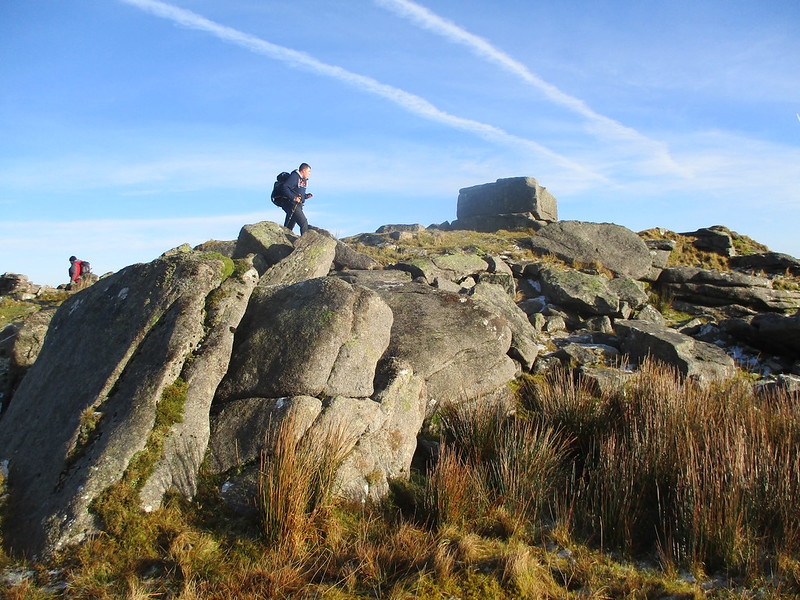 Although at a slightly higher altitude than the nearby lower group, this tor is much less impressive than its neighbour. First mentioned in the literature as Higher Danagoat or Dunagoat Tor (HDT) by Samuel Rowe in 1848 and its height above sea level given as 1845 ft, it is a rather scruffy pile, with no towering walls or precipitous drops. Later in 1867 the tors here are mentioned again, this time by Horace Waddington as part of his account of a walk across the north moor facilitated by none other than the noted Dartmoor Guide and founder of the Cranmere Pool Letterbox James Perrot of Chagford. Here we learn the origins of the name cited as Dunnagoat by the author but interpreted as 'Dun-a-coet', a Saxon phrase for 'underwood'. This point is agreed in principle by William Crossing in 1912 as possibly being derived from "the former presence of trees in the valley of the Rattle Brook. Even now in parts of it a solitary rowan, or oak, is to be met with." 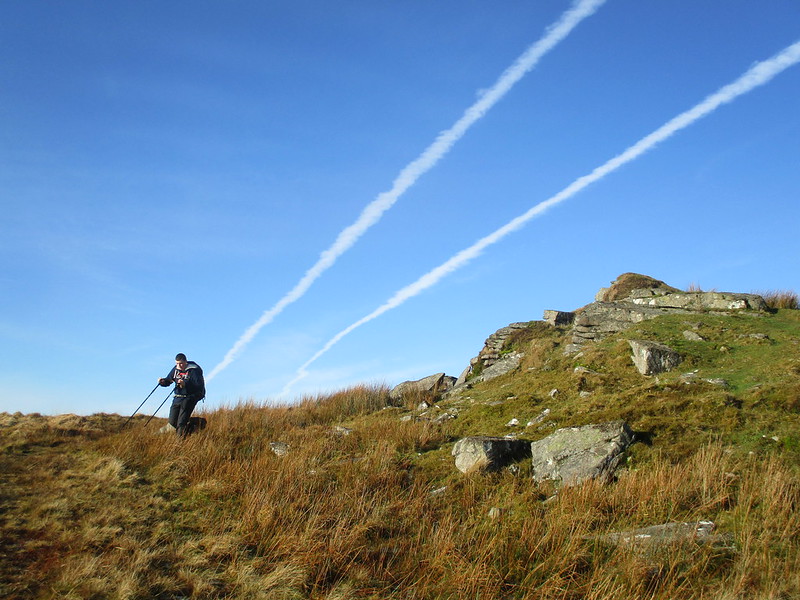 HDT simply comprises a squat main outcrop with a curious square block atop and is suspected by Hemery (1983) to have lost at least "some of its erstwhile dignity through the assaults of granite cutters in selecting stone - tare and feather marks being everywhere about - for the building of Bleak House" or Dunnagoat Cottage that is set down to the east, a now crumbling ruin that William Crossing (1912) advises was once associated with the peat works but only for a short time. Interestingly from a communication in 1986 it seems that the National Park was once considering a repair to the house. 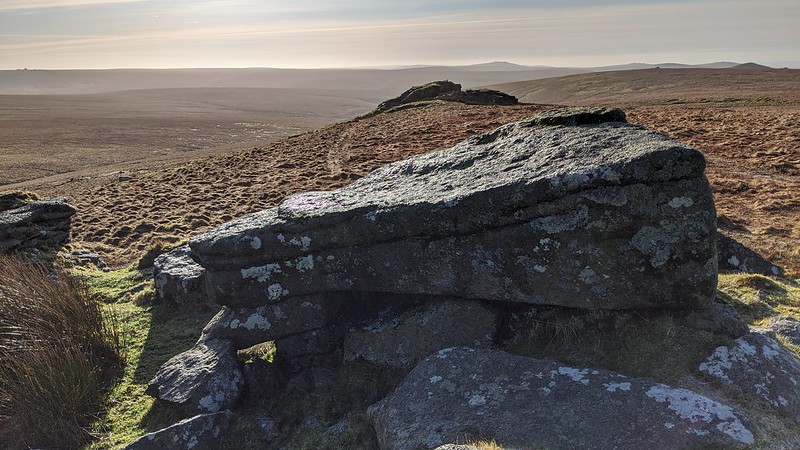 According to a letter to the Western Evening Herald from a Mr P. Rendell of Plymouth under the heading 'Far Too Late', he writes: "It's a pleasure to read that Dartmoor National Park Committee are thinking of restoring Bleak House. This should have been done many years ago when the chimney fell down. It is a bit late in the day now to try and repair this decaying ruin. Notices were placed on the building in 1985 'Dangerous walls keep well clear', they went missing but were soon replaced. I hope they repair what is left and tidy up the site of this peat cutter manager's house before it collapses completely." Despite this noble sentiment nothing much seems to have been done since this date and the building continues to wear away at the mercy of the elements. 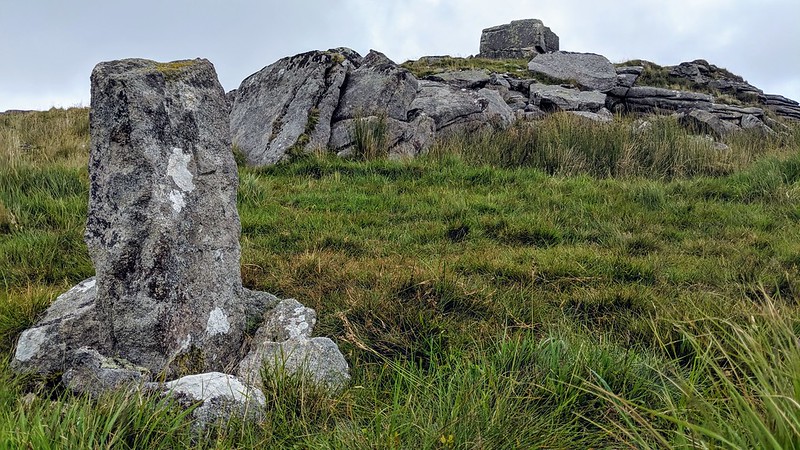 The view from the summit of Higher Dunnagoat is exhilarating and Hemery remarks: "Vur Tor and Cut Combe make a wild background to the eastward view, while very close at hand is a bond-stone bearing an anciently cut 'B' on its north face, one of the line marking the boundary between the Commons of Bridestowe (and Sourton) and Lydford." That said there is also an 'L' on its south face (see above) that the author somehow failed to notice.
| ||||||||||||||||||||||||||||||
