TORS OF DARTMOOR

a database of both lesser- & well-known rocks and outcrops

Home Search Map Access About Team Blog Social YouTube

Little Sharpitor

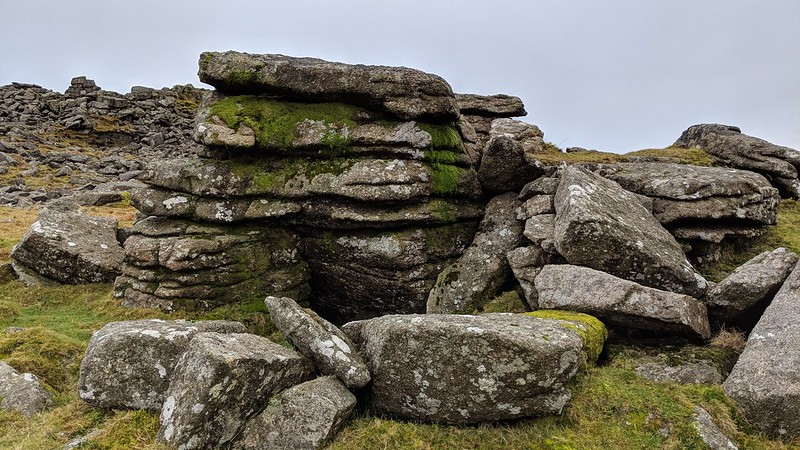
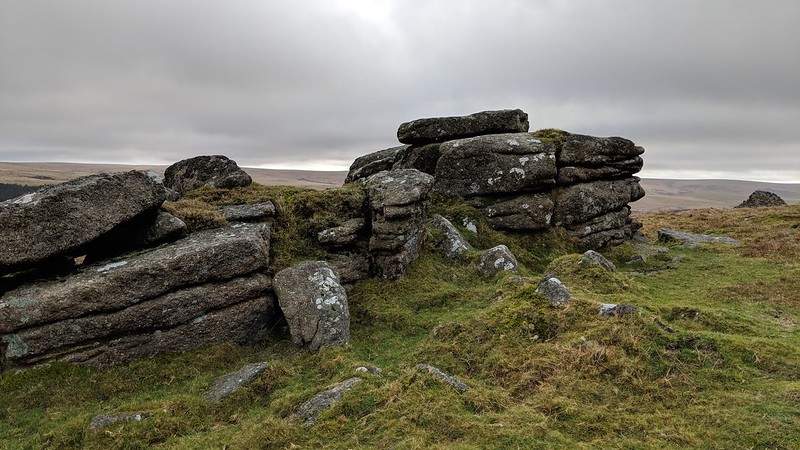
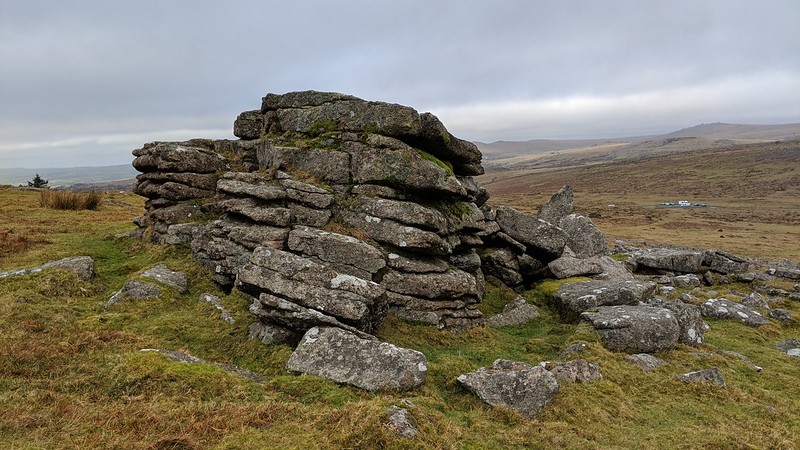
This small tor can be found to the north-east of Sharpitor proper, at about 100 metres or so below it and is completely dominated by the sprawl of granite on the slope here which could be the reason why this quite obvious outcrop has not been given any recognition until now. Whilst it sits amid the extensive clitter of its larger neighbour, Little Sharpitor is actually not connected to its massive bulk, and when seen from atop of Sharpitor, it is indeed a separate entity, or an outlier as there is a definite gap. It is essentially a sole compact outcrop of fissured granite looking downhill.
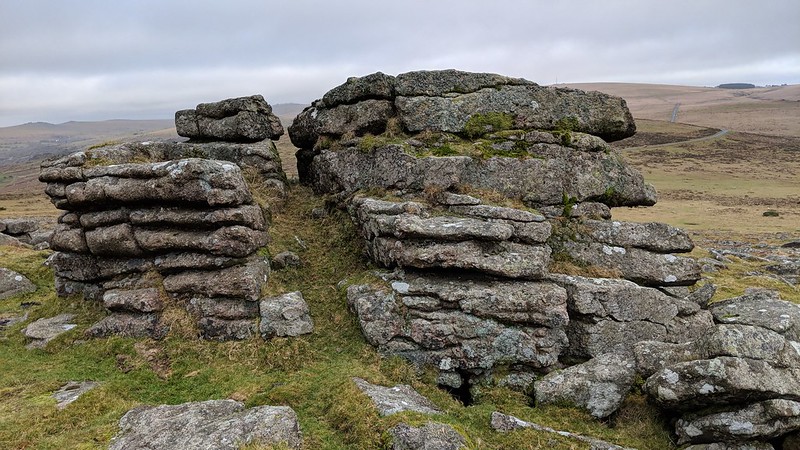
In February 1984, a parcel of near 30 acres of land around the rocks was purchased by the Dartmoor Preservation Association (DPA) making it their very own tor. This is part of that set within the boundary. The land here was bought after a protracted negotiation to protect the tor's substance from any kind of development or neglect such as that which occurred post World War Two (1956), with the abandonment of old wartime installations such as the transmitting station at RAF Sharpitor on nearby Peek Hill. To commemorate the achievement, the Authority duly erected a series of five small boundary stones inscribed with their initials that are carved into an oval panel. There is one not far from the rocks at SX 56102 70228 (see fourth photo).
For more clarity, this account appears on the DPA website:
"During World War II, RAF Sharpitor was established on Peek Hill, featuring a mast and buildings. In 1956, the station granted permission to be reconstructed for the "Gee" radio navigation system and intended to be occupied for a decade. However, delays occurred and the proposal came to nothing.

Subsequently, Devon & Cornwall Police and Plymouth Corporation attempted to gain permission to build a reform school at Sharpitor. A public inquiry in June 1973, attended by Lady Sylvia Sayer representing the DPA, resulted in the refusal of development on the site. Later, the DPA successfully campaigned against South West Water constructing a reservoir at Swincombe. In celebration of the victory, Sylvia Sayer approached SWW to purchase the rocky outcrop of Sharpitor. The DPA acquired 32 acres of land in February 1984.

There are currently no ongoing projects on the land, but its vast ruggedness, often visited by ponies and cattle, remains a characteristic icon of the Dartmoor skyline thanks, in part, to the work of the DPA.
"

Little Sharpitor was first described by Rob Naylor on the website 'Dartefacts' where he writes: "On a whim I decided this little rocky outcrop deserved a name. It is set just enough away from Sharpitor to feel like a little rock island that deserves a little recognition." There is a good angle to the south of here on the conical Leather Tor that is impressive. To access the tors in this area it is probably best to park at one of the large car parks on the B3212 and walk in a southerly direction over the main tor, taking in the absolute ruin of rocks all around.


icon icon
Little Sharpitor
The map above is not a navigation tool and we recommend that the grid reference shown below is used in conjunction with an Ordnance Survey map and that training in its use with a compass is advised.
Grid Ref:
SX 5603 7038
Height:
395m
Parish:
Walkhampton
Tor Classification:
Small
Access:
Public
Rock Type:
Granite
Credit:
Rob Naylor
Reference / Further Reading:
Dartefacts: Little Sharpitor
Dartmoor Preservation Association (2026): Sharpitor
Piper, M. (2019): Gipsy Rock and Peek Hill

Please Support Us

We are proud to see the names of lesser-known tors are now being used more commonly on other websites and whilst this is to be encouraged we do request that, should you wish to use the information on this page, you provide a backlink to the website as reference, by copying the relevant address:

https://www.torsofdartmoor.co.uk/tor-page.php?tor=little-sharpitor

Please also consider a small donation to the upkeep of the site; any contribution goes toward the fees to keep the database online and any costs incurred when undertaking research such as subscriptions to online archives.