TORS OF DARTMOOR
a database of both lesser- & well-known rocks and outcrops
Manga RockManger Rock 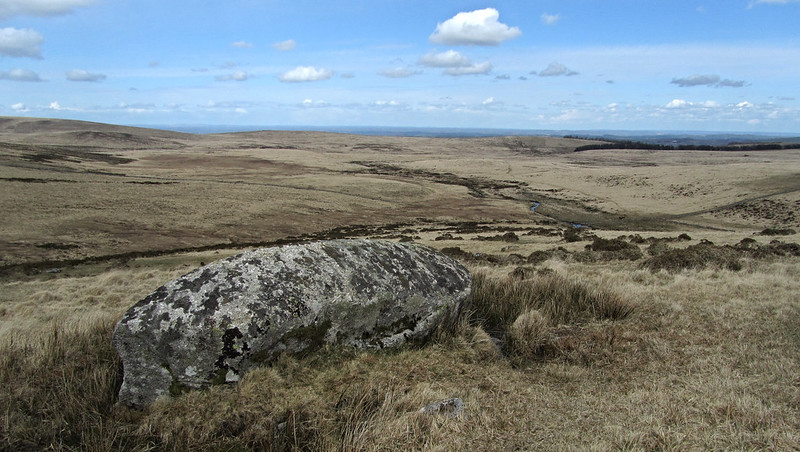 You might be wondering why such an insignificant rock as this would be named, but Eric Hemery (EH) assures us; "Small rock outcrops occur on the north-east shoulder of the hill of which one, an elongated lump of bedrock known as 'Manga Rock', bears on its north face the letters 'GP', for here runs the boundary line east to Stone Tor, north-west to Hawthorn Clitter." There is a medium sized rock with an oval appearance in an otherwise area of scattered boulders on the north slope of Manga Hill, away to the south of Hugh (Hew) Lake with good views eastward over the Shovel Down antiquities. This peculiar landmark is very well documented in the literature as a boundary stone and has, as EH explains, the initials 'GP' for Gidleigh Parish engraved on its northern face although the letters are now quite worn and rather difficult to discern. Every seven years Gidleigh Parishioners and others who fancy the long walk embark on a Beating the Bounds excursion that takes in numerous moorland stones that are similarly inscribed, though some with just a simple 'G'. 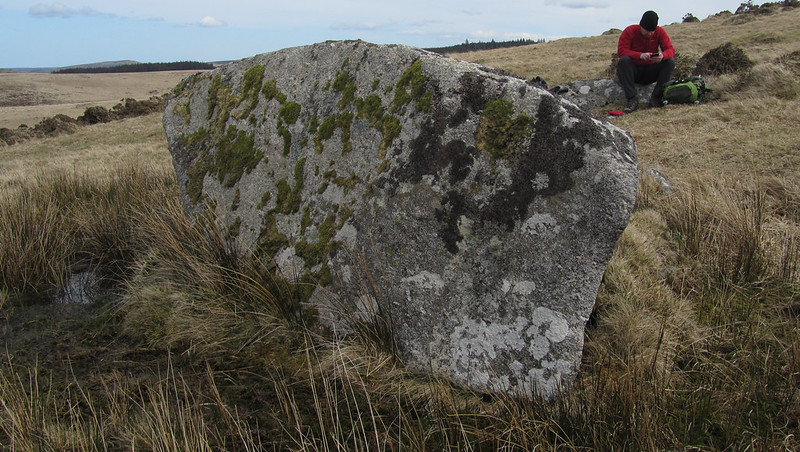 We learn from marker stone expert Dave Brewer (2002) that the modern boundary between the Duchy and Gidleigh was agreed on March 25th 1843 at Moretonhampstead as the various Tithe Maps for Dartmoor were being prepared. Manga Rock is the best-known stone on this route. Indeed it is also referred to as 'Manger Rock' by DB and appears by that name on late 19th-Century Ordnance Survey Maps of this area. 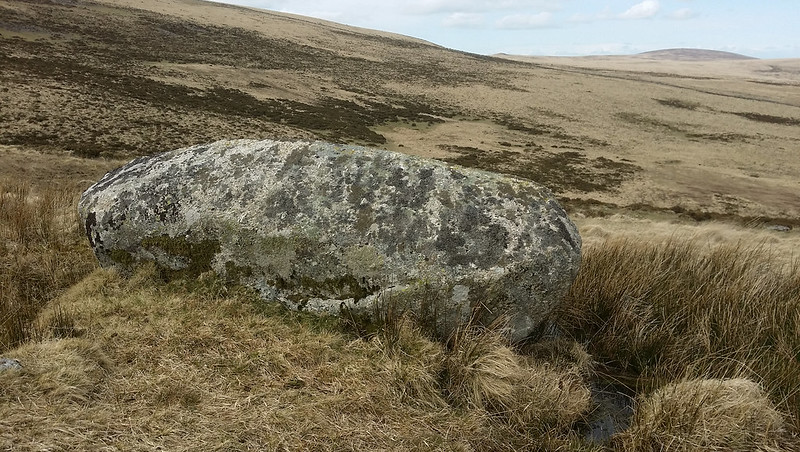 It is a remote spot on the North Dartmoor scene and the name of the Rock with the local hill and brook is also linked to the remnants of the nearby abandoned Manga and Teignhead Farms. These fascinating ruins add interest to a visit for exploration purposes with several agricultural artifacts such as troughs and gateposts still in evidence within the granite enclosure walls.  For the best, most definitive and detailed account of the various tenants of the farmsteads here you are directed to the work on Dartmoor Forest Farms from 1994 by the founder and first editor of Dartmoor Magazine Elisabeth Stanbrook (see reference list below). In this account she provides evidence from a letter written by a Mr James Lamb to the Duchy that Manga Farm had fallen into ruin by 1884 it being in a "long dilapidated" state without its roof. Today there are some low walls surviving and an old trough is set by what might have been the doorway of a much smaller building when compared with the sprawling Teignhead complex to the south.
| ||||||||||||||||||||||||||||||
