TORS OF DARTMOOR
a database of both lesser- & well-known rocks and outcrops
Prince Hall Rocks
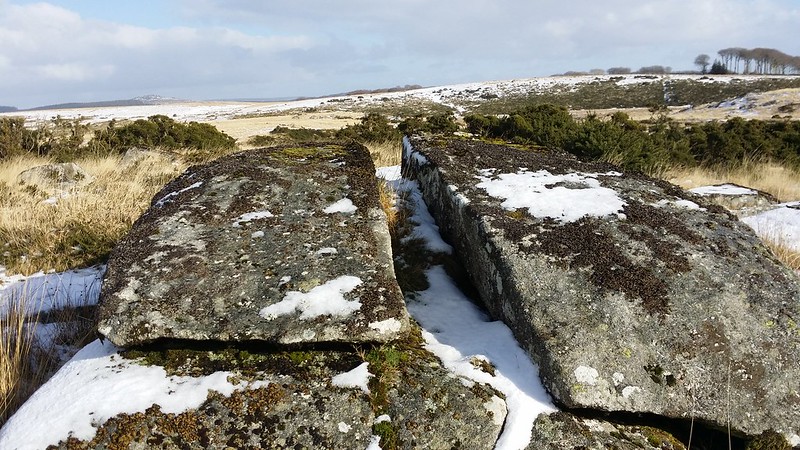 Although many will have seen these lowly rocks to the right of the road (B3357) passing between Two Bridges and Prince Hall, we first learn of their name from Eric Hemery in 1983 where, on page 391 of High Dartmoor in the chapter 'Blacka Brook Country', he writes: "Some hut-circles are seen at the south-west foot of the hill, and others are involved in the rocks of a diminutive pile, called Prince Hall Rocks, at the foot of the peninsula - the name being shared by a correspondingly small pile on the opposite bank." On the next page he adds more detail: "Blacka Brook passes over a rocky bed between the portals of Prince Hall Rocks." These are important descriptions because they indicate that the Rocks are on each side of the river. 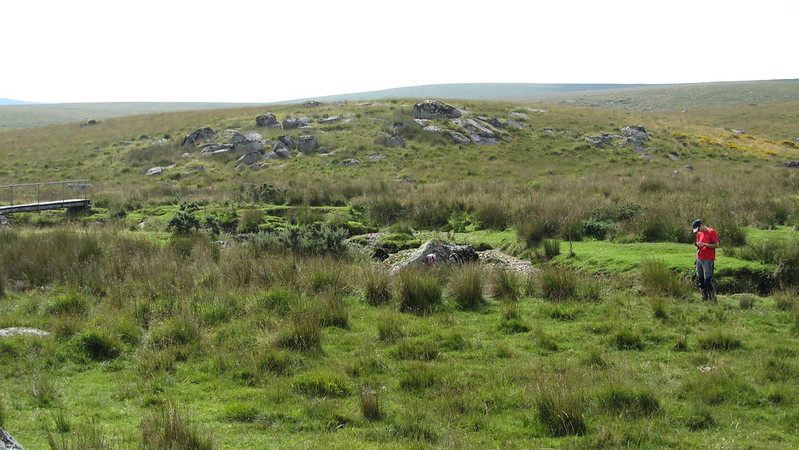 The name resurfaces in 1995 with the publication of Mike Brown's Gazetteer, but the grid reference he supplies was later found to be incorrect as it is way too far to the west. Writing in 1996, Tim Jenkinson (TJ) in his account of the nearby Roundhill Tor supplies this information: "The scene from the tor's highest point is unique. The visitor is able to take in not only fine views to the south and east that includes the Blacka Brook as it curls towards its confluence with the Dart beneath Prince Hall Rocks but also westward where a most unusual angle on Dartmoor's prison is obtained." Posted on Flickr in 2012 the first colour photographs of the site emerge along with a grid reference of SX 6166 7408 for the south section courtesy of TJ. Nevertheless, the following year Ken Ringwood reverts to the western site at some 250 metres away where nothing much resides giving a misleading GR of SX 6140 7410. Whilst there are a couple of large flat boulders here, they do not match Hemery's earlier assertion of being on either side of the river. 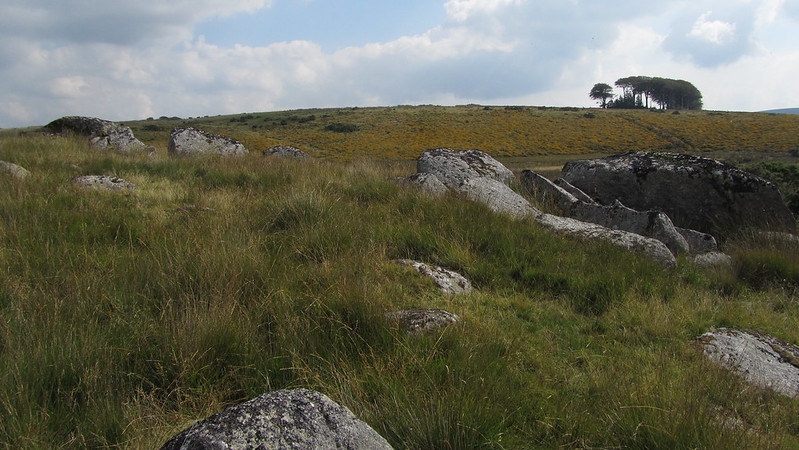 The official location is right where Hemery suggests, with a now connecting wooden footbridge known as the Angler's Bridge between. The better and more impressive group of rocks is without doubt the southern set, where a small pile gives rise to a scattered clitter of fair-sized boulders. These are the ones visible from the road. On the opposite bank across the aforementioned bridge and tucked under the slope is a much smaller and less obvious cluster but nonetheless fitting Hemery's description. 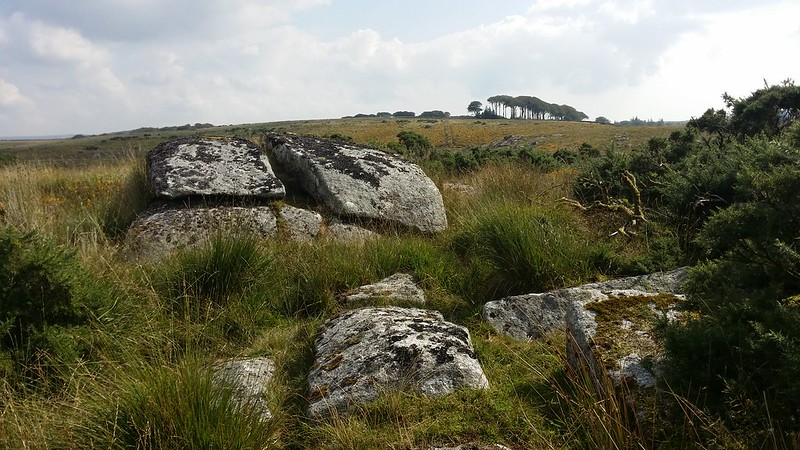 Despite their closeness to the B3357, Prince Hall Rocks still require some effort to reach. The best way is to come in from the west via the public bridleway to Round Hill and then over another footbridge heading east for Blakey Tor and its antiquities then heading north. You can still get a sense of solitude whilst stood at the Rocks and a feeling that you are in an area that is rarely visited. Royal Tor is set to the south and can also be reached with the chance to turn it into a full day's excursion to bag four lesser-known tors and rocks.
| ||||||||||||||||||||||||||||||
